If I’m buying in the GCC, this is the short version: PIF’s car bets could mean more local EV supply, lower import friction on Saudi-built cars, and a larger charging footprint over the next few years. For me, the biggest buyer checks are simple: price, charging, service, heat readiness, and resale.
Here’s what stands out straight away:
Saudi-built cars can move across GCC markets duty-free, which may help pricing in the UAE.
EVIQ plans 5,000+ fast chargers across 1,000+ sites by 2030, which matters if I’m thinking about an EV.
The plant in KAEC is targeting 150,000 cars a year by 2029.
PIF wants to back 500,000 EVs a year by 2030.
Ceer is due in Q4 2026.
In the UAE, the Lucid Air starts at about AED 313,635, while the Gravity is expected from around AED 270,000.
This is less about finance headlines and more about what I can live with day to day. If local production grows as planned, I’d expect better stock, more charging points, and easier parts supply. The weak spot is still resale, mainly for Ceer and newer EV names.
Quick comparison
Brand | What it adds | Likely buyer focus | Main watch-out |
|---|---|---|---|
Ultra-luxury | Status, GT comfort, low-volume SUV/coupe choice | High depreciation | |
Performance halo | Speed, track use, rarity | High running costs | |
Premium EV range and local assembly | Long range, fast charging, EV tech | Heavy spending still needed | |
Ceer | Saudi-built family EVs | Price, local fit, GCC heat setup | No resale history yet |
So if I’m comparing these four brands, I’d read the market like this: Aston Martin is the luxury play, McLaren is the performance name, Lucid is the premium EV push, and Ceer is the bet on more reachable Saudi-built EVs for GCC roads.
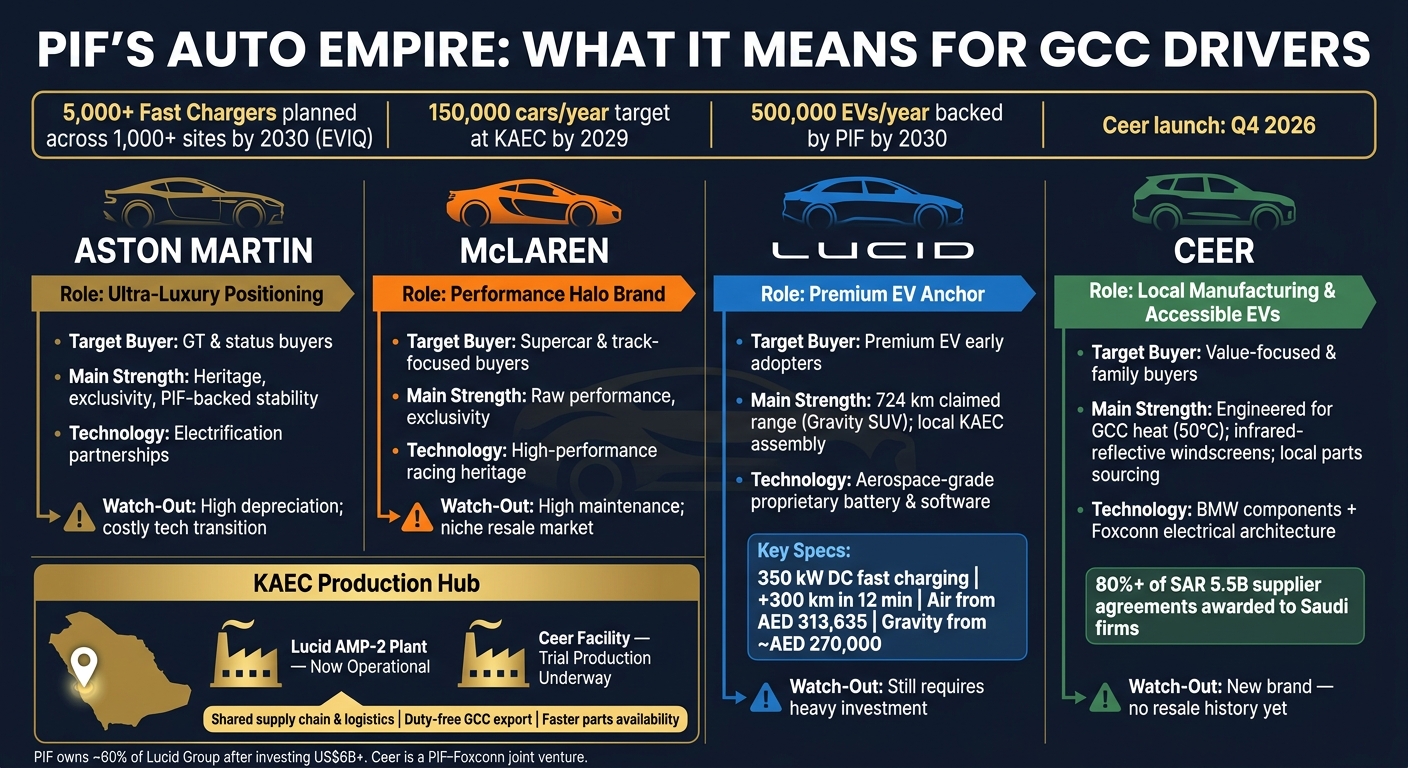
PIF's 4-Brand Auto Portfolio: GCC Buyer Guide 2024–2030
How PIF connects these four brands into one plan
PIF’s auto portfolio is built around four clear roles: luxury, performance, premium EVs, and local manufacturing. The idea is simple. It’s not just about owning car brands. It’s about pairing financial returns with technology transfer and industrial growth in Saudi Arabia.
That matters in practical terms. These brands shape what GCC drivers can buy, how soon they can get it, and how easy ownership will feel day to day.
Brand | Role in the Portfolio | Key Technology or Partner |
|---|---|---|
Lucid | Premium EV anchor | Proprietary aerospace-grade battery and software |
Ceer | Saudi EV brand for the GCC | |
Aston Martin | Ultra-luxury positioning | Electrification partnerships |
McLaren | Performance halo brand | High-performance racing heritage |
Aston Martin: luxury positioning and EV technology links
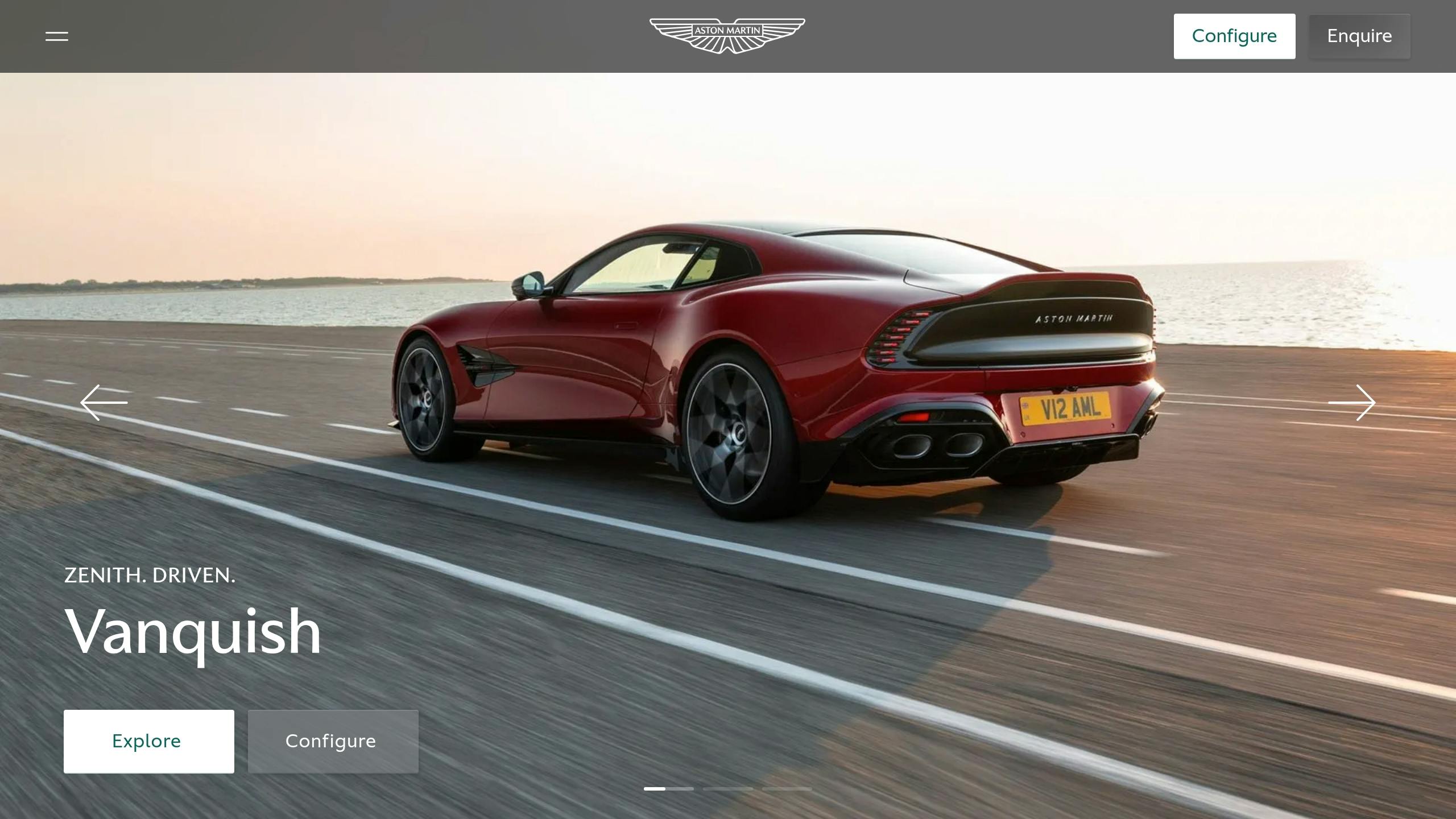
Aston Martin sits firmly in the ultra-luxury segment in the GCC. It appeals to buyers looking at top-end SUVs and grand tourers. The brand has confirmed electrification partnerships to support its move towards electrified models.
For GCC buyers, that likely means Aston Martin remains centred on low-volume luxury as its EV plans move forward. So the role here is less about mass-market reach and more about keeping ultra-luxury choice on the table.
McLaren, Lucid and Ceer: performance, EV scale and local industry
McLaren is the performance halo brand. In plain terms, it gives PIF’s auto mix a high-performance edge and keeps that part of the market in view for GCC buyers.
Lucid is the EV and technology anchor. PIF owns about 60% of Lucid Group after investing more than US$6 billion. Lucid also anchors local EV production in KAEC, which supports regional EV supply and a software-led ownership experience.
Ceer plays a different role. It is the local manufacturing brand, set up as a joint venture between PIF and Foxconn. It uses licensed BMW component technology to build affordable, practical EVs for Saudi Arabia and the wider GCC. Its facility is being built in KAEC alongside Lucid, which creates shared supply and logistics gains. Ceer has already awarded more than 80% of its SAR 5.5 billion supplier agreements to Saudi-based firms.
Put that together and the plan becomes pretty clear:
McLaren keeps performance in the picture
Lucid brings EV scale and in-house tech
Ceer pushes local production and more accessible EV ownership
KAEC ties assembly, parts, and logistics into one hub - a move away from import-led sales and towards local production. For buyers, that shift will show up most clearly in availability, charging, and service support.
What GCC drivers are likely to notice first
For GCC buyers, the first thing that matters isn't who owns the brand on paper. It's what actually changes on the ground - in showrooms, at charging bays, and inside service centres.
Model availability, waiting times and segment choice
The next phase for buyers in the GCC will likely come down to two arrivals. The Lucid Gravity SUV, with a claimed range of 724 km, and Ceer, which is aiming for a commercial launch in Q4 2026, with pre-orders already open, are the main names to watch.
There's a practical reason these two matter. Lucid's AMP-2 plant in King Abdullah Economic City (KAEC) is now fully operational, and Ceer is moving through trial production in KAEC. That should help with supply and cut reliance on imports.
In simple terms, cars built closer to home usually mean fewer shipping bottlenecks and, over time, shorter waits.
Buyers should still expect the higher-spec trims to arrive first. Broader model and variant choice will likely come later.
And once more cars start reaching customers, the next pressure point becomes obvious: charging and aftersales.
Charging, service and ownership support in the UAE and GCC
The ownership picture is starting to look better beyond the car itself. Lucid had already deployed 100 free chargers across Saudi Arabia as of May 2026. For UAE buyers, that's a good sign for the region's charging setup over time.
Service matters just as much, maybe more. Ceer is being engineered for GCC conditions, with infrared-reflective windscreens and specialised thermal management systems built for extreme 50°C heat. That means EVs designed with local weather in mind, backed by local parts and, ideally, faster support.
There's also work happening behind the scenes. Training programmes through HRDF and NAVA are helping build a pool of EV-trained technicians. That's a big deal for long-term service confidence, especially in hotter markets where heat can put extra strain on vehicles. Local production is also helping build a local supply chain, which should improve parts availability and reduce wait times over time.
Put together, these shifts may matter more in day-to-day ownership than the headline price on a brochure.
In the near term, buyers are likely to see more EV choice, more visible support, and slow but steady gains in service.
Buying impact: price, running costs and resale risk
As support and availability get better, the next thing buyers look at is total cost of ownership. PIF backing doesn't automatically make these cars cheaper to own. What it does help with is long-term support, steadier supply, and more buyer confidence.
From a buying point of view, each brand fits a different budget and a different kind of owner.
Brand | Target Buyer | Main Strength | Primary Risk |
|---|---|---|---|
Aston Martin | Ultra-luxury GT buyers | Heritage, status, PIF-backed stability | High depreciation; costly tech transition |
McLaren | Supercar and track-focused buyers | Raw performance, exclusivity | High maintenance; niche resale market |
Lucid | Premium EV early adopters | Long-range capability; local manufacturing at KAEC | Still requires heavy investment |
Ceer | Value-focused and family buyers | Engineered for GCC heat; local parts sourcing | New brand with no historical resale data |
In the UAE, the Lucid Air starts at about AED 313,635, while the upcoming Gravity SUV is expected to start from around AED 270,000.
Running costs tell a slightly different story. EVs like Lucid can be easier on the wallet over time, thanks to Salik toll exemptions and lower registration fees in the UAE. Charging is also less of a hassle than many people expect. Lucid's 350 kW DC fast charging can add up to 300 km of range in only 12 minutes. For daily use, that makes a big difference.
Resale is where newer names still have work to do. That's the plain truth. New EV brands tend to carry more resale uncertainty than established luxury marques. Ceer, for example, has no past resale data yet. If resale liquidity matters to you, that should stay high on your checklist.
After price, running costs, and resale, the fastest way to gauge the market is to look at live listings. YallaMotor lets you browse current Lucid Air, Aston Martin, and McLaren listings, compare asking prices, and keep an eye on early Ceer availability once the brand launches in Q4 2026.
Conclusion: What PIF's car portfolio means for GCC drivers
PIF's stakes in Aston Martin, McLaren, Lucid, and Ceer make the most sense when you see them as one linked plan. The goal is to move Saudi Arabia from relying on imports to building cars at home, with Lucid and Ceer leading production while Aston Martin and McLaren add the luxury and performance edge.
For GCC drivers, this matters in day-to-day terms. It should affect which models are easier to get, how charging networks grow, and what ownership support looks like over time. In plain English: more premium choice, better EV access through local production, and stronger regional support backed by local supply chains and charging infrastructure.
The main things to watch before buying haven’t changed:
stock availability
charging coverage
after-sales support
resale confidence
That last point matters even more for newer names like Ceer, which still has to prove itself with service and warranty support over time.
Track confirmed launch dates before you change your buying plan. Use YallaMotor to compare live listings and ownership signals before you buy.
FAQs
Will Saudi-built EVs be cheaper in the UAE?
It comes down to brand positioning.
Ceer is built around affordability and day-to-day practicality in Saudi Arabia and across the GCC. Its target price range starts at SAR 120,000 and goes up to SAR 250,000.
Since it’s made within the GCC, it may also sidestep some import duties and shipping costs. That could help keep prices in check.
Lucid sits in a different lane. It’s still a premium luxury brand, so making cars in the region is more likely to improve availability than bring prices down.
How soon will charging and service improve across the GCC?
Charging and service for EVs across the GCC are getting better step by step. One of the biggest moves here is EVIQ, a joint venture between PIF and the Saudi Electricity Company. Its plan is to roll out more than 5,000 fast chargers across 1,000+ locations by 2030.
In major cities like Riyadh, Dubai and Muscat, urban charging is already fairly dense. That matters because day-to-day charging has to feel easy, not like a chore.
Beyond city driving, intercity high-speed charging is also growing. Service support is moving in the same direction, including battery diagnostics and technician training. On top of that, power stability projects are expected to improve the setup further by late 2026.
Is it safer to buy Lucid or wait for Ceer?
It comes down to what matters more to you: a car brand with a track record or a home-grown name to watch.
Lucid is already established in the luxury EV space. Its cars are on the road today, and it has an operating assembly plant in King Abdullah Economic City. That gives buyers something concrete: a brand people can already see, drive, and own.
Ceer is at a different stage. It’s a new Saudi brand aiming for a late 2026 commercial launch, so it doesn’t yet have a consumer ownership history. In simple terms, Lucid is available now, while Ceer represents a future mass-market step for the Kingdom.