If I want to spend less on transport in the UAE, I focus on three things: the right card, the right pass, and the right transfer timing. In Dubai, that usually means using a Nol card, staying alert to zones, and making transfers within 30 minutes so one trip does not turn into two fares. For regular travel, a Silver monthly pass can cost AED 140 for 1 zone, AED 230 for 2 zones, or AED 350 for all zones.
Here’s the short version:
Dubai: I use Metro for longer trips, buses for local links, Tram for Marina and JBR, and abra for creek crossings from AED 1.
Abu Dhabi: I use the Hafilat card for buses.
Sharjah to Dubai: I can cut costs by taking an intercity bus first, then switching to the Dubai Metro instead of using taxis for the last part.
Watch the rules: I need at least AED 7.50 on a Nol card to start a trip, and if I miss a tap in or tap out, I may be charged the maximum fare.
Plan first: Apps like S'hail and RTA tools help me compare time and fare before I travel.
Big cost check: A Dubai all-zones Silver pass is AED 350 per month or AED 4,200 per year, which gives me a simple way to compare public transport with car costs like fuel, Salik, parking, insurance, and maintenance.
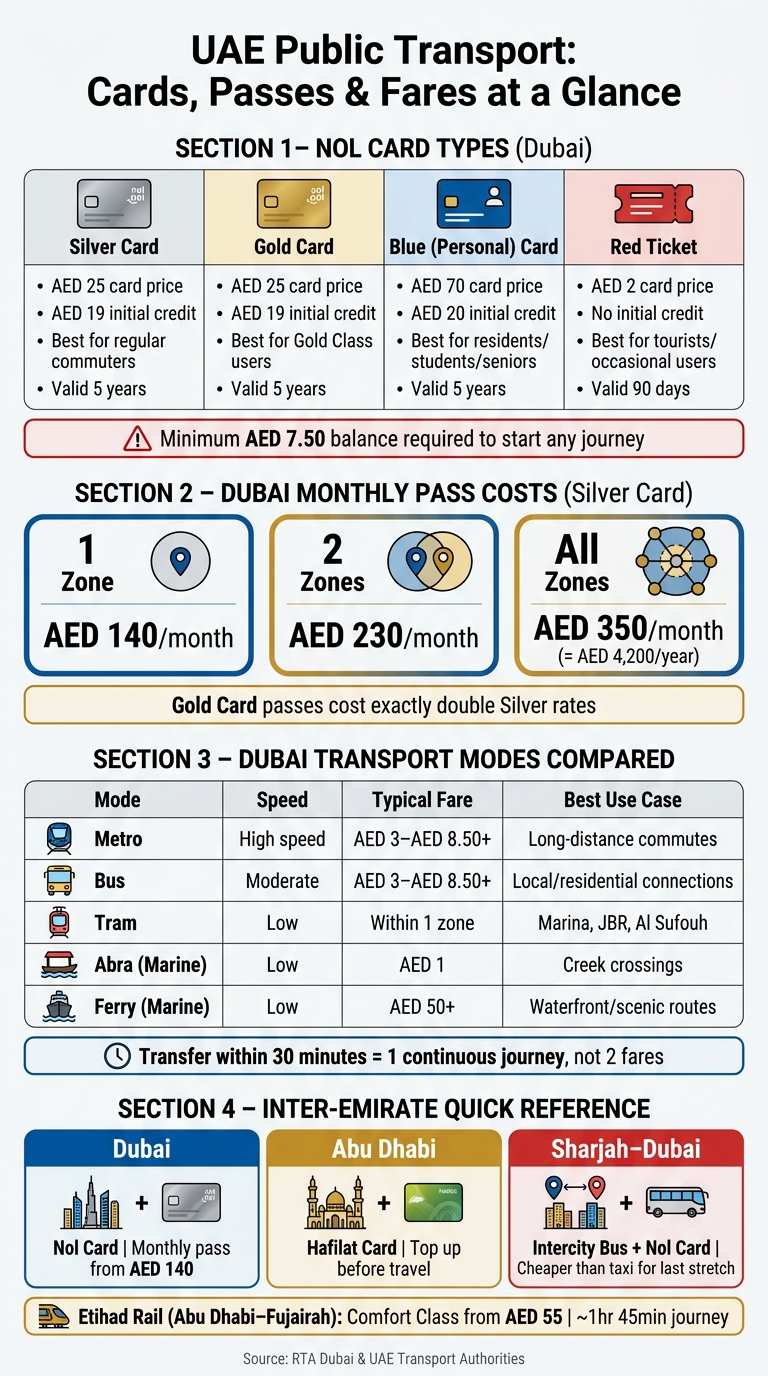
UAE Public Transport Cost Guide: Cards, Passes & Fares Compared
Quick Comparison
Area / Mode | Main payment method | Best for | Key cost point |
|---|---|---|---|
Dubai Metro, bus, Tram | Nol card | Daily city travel | Monthly passes from AED 140 |
Dubai abra | Nol / cash route rules may vary by service | Short creek crossings | From AED 1 |
Abu Dhabi bus | Hafilat card | City bus travel | Top up before travel |
Sharjah–Dubai intercity bus + Metro | Intercity fare + Nol card for Dubai leg | Daily cross-emirate commute | Often cheaper than taxi links |
Etihad Rail (Abu Dhabi–Fujairah) | Rail ticket | Longer inter-emirate trips | From AED 55 in Comfort Class |
My main takeaway is simple: public transport in the UAE is easiest on my budget when I match the card and pass to my travel pattern, keep trips within the right fare rules, and avoid paying extra for short taxi hops.
Dubai public transport: Metro, buses, Tram, marine transport and Nol
Dubai is one of the easiest places in the UAE to get around by public transport day to day. The Metro, buses, Dubai Tram and marine transport all run on Nol, so you can move from one mode to another without changing how you pay. That makes a big difference on busy days.
Each part of the network has its job. The Metro handles longer trips across the city. Buses cover residential areas that Metro stations don’t reach. The Tram is built for shorter trips around Dubai Marina and JBR. And if you need to cross the creek, the old-school abra is still the cheapest ride in town at AED 1 per trip.
Dubai fares are based on zones crossed, not the number of stops you travel. So one small mistake can cost you: if you miss your tap-out, the system charges the maximum fare for that trip. Another place people save money is on transfers.
The 30-minute transfer rule helps you avoid paying twice. If you switch from the Metro to a bus, Tram or another mode within 30 minutes of tapping out, it counts as one continuous journey. That’s why interchange stations matter. Union and BurJuman connect the Red and Green Metro lines, while DMCC and Sobha Realty link the Metro straight to the Tram.
Nol card types, top-ups and passes
The Nol card you pick affects both access and cost. If you commute often, the Silver Card is the usual pick. If you want Gold Class cabins, go for the Gold Card. If you live in Dubai and want balance protection in case the card is lost, the Blue (Personal) Card makes more sense. For tourists or people who only ride now and then, the Red Ticket keeps things simple.
Card | Price | Initial Credit | Best For | Validity |
|---|---|---|---|---|
Silver | AED 25 | AED 19 | Regular commuters | 5 years |
Gold | AED 25 | AED 19 | Gold Class users | 5 years |
Blue (Personal) | AED 70 | AED 20 | Residents, students, seniors | 5 years |
Red Ticket | AED 2 | None | Tourists, occasional users | 90 days |
There’s one small rule that catches people out: you need at least AED 7.50 on your card to start any journey. And if you top up at a Metro Station Ticket Office, the minimum top-up is AED 20 as of 1 March 2025. If you only want to add a smaller amount, use ticket machines or the S'hail app.
If you travel often, a monthly pass can cost much less than paying trip by trip. On a Silver Card, a one-zone monthly pass costs AED 140, two zones cost AED 230, and all zones cost AED 350. Gold Card passes cost exactly double those Silver rates.
Travel Pattern | Best Option | Monthly Cost |
|---|---|---|
Occasional (1–2 times/week) | Pay-per-trip | Only pay for what you use |
Daily, 1 zone | Monthly Pass | AED 140 |
Daily, 2 zones | Monthly Pass | AED 230 |
Daily, cross-city | All-zones Pass | AED 350 |
How to use the Metro, buses, Tram and ferries without overpaying
Think of Dubai’s network like a set of tools. You don’t use a bus the same way you use the Metro.
The Metro is the fastest choice for longer commutes. It links places like Dubai International Airport, Sheikh Zayed Road and Expo City without getting stuck in road traffic. Buses take more time, but they reach many more neighbourhoods. The Tram is made for the Marina, JBR and Al Sufouh stretch, running between Sobha Realty and DMCC and connecting to the Metro at both ends. Marine transport covers creek crossings and waterfront routes, with fares starting at AED 1 for a traditional abra and going to AED 50+ for longer ferry rides.
Mode | Speed | Coverage | Typical Fare | Best Use Case |
|---|---|---|---|---|
Metro | High | Airport, SZR, major hubs | AED 3 – AED 8.50+ | Long-distance commutes |
Bus | Moderate | City-wide, residential areas | AED 3 – AED 8.50+ | Local connections off Metro lines |
Tram | Low | Marina, JBR, Al Sufouh | Within 1 zone | Short trips along the coast |
Marine (Abra) | Low | Dubai Creek | AED 1 | Quick creek crossings |
Marine (Ferry) | Low | Canal, Marina, coastal routes | AED 50+ | Scenic or waterfront travel |
The trick is to combine modes in a smart way instead of treating each ride as separate. A Metro-to-bus transfer made within 30 minutes still counts as one continuous journey. Hubs like Al Ghubaiba and Ibn Battuta are handy because Metro, bus and marine services come together there.
Route planning with S'hail and RTA tools
Before you head out, check the route in S'hail. The app lets you compare options by both time and fare, using your start and end points to show routes ranked by travel time and cost. That’s useful when two routes look similar but one is cheaper.
It also shows live timings and route combinations, which can save you from guessing and missing a connection. One practical move is to compare a taxi fare against a public transport trip in S'hail before booking a ride. If you’d rather use a browser, the RTA website gives you the same route-planning tools.
Abu Dhabi, Sharjah and inter-emirate travel
Dubai's Nol system gets most of the spotlight. But if you live or work outside Dubai, the setup looks different.
In Abu Dhabi and Sharjah, you'll use other cards, other bus networks and other fare systems. The money-saving idea, though, stays the same: use the local network, switch early, and skip taxis for short hops.
Abu Dhabi buses and the Hafilat card

Abu Dhabi buses use the Hafilat card. Top it up before you travel so you don't get held up at the station or onboard.
Sharjah buses and Dubai-Sharjah daily commutes
If you commute between Dubai and Sharjah, a smart move is to take an intercity bus into Dubai first, then finish the trip on the Metro. Intercity buses from Sharjah connect with major Dubai Metro hubs such as Al Ghubaiba, Union and Etisalat stations.
Use your Nol card for the Dubai part of the journey, and avoid taking a taxi for the last stretch if you can. For many daily commuters, that's where costs start to pile up.
Intercity buses between major emirates
For longer trips, it helps to think less like a daily commuter and more like someone booking a direct ride from one city to another. In many cases, intercity buses are the cheapest road option for longer inter-emirate travel. Dubai–Abu Dhabi buses run from Ibn Battuta and Al Ghubaiba.
As of 2026, Etihad Rail has introduced a passenger service connecting Abu Dhabi Station in Mohamed Bin Zayed City with Fujairah Station in Al Hilal City. The trip takes about 1 hour and 45 minutes. Comfort Class starts at AED 55, while Premium Class starts at AED 120.
How to cut your daily commuting costs in the UAE
Once you know your route, the next place to save is simpler than it sounds: your card, your zone count, and your transfer timing.
Pick the right card and pass for your travel pattern
For daily Dubai commuters, the Silver Nol card is usually the standard pick. But the bigger money saver is the pass you load onto it.
Match the pass to the way you travel. A 1-zone monthly pass costs AED 140, a 2-zone pass costs AED 230, and an all-zones pass costs AED 350. If you cross two zones every workday, the AED 230 option often makes more sense than paying for each trip separately. On the other hand, the Red Ticket is better for occasional rides, not daily commuting.
Cut fare costs through zones, transfers and short walks
The basic rule is straightforward: fewer zones usually mean lower fares.
That’s why small route changes can make a big difference. If your office is just inside a zone boundary, it may be worth walking to the nearer station if that keeps your trip in a lower fare band. That one adjustment can save you AED 90 per month on a monthly pass.
Timing matters too. Under the 30-minute transfer rule, if you move from the Metro to a bus or tram within 30 minutes, the system treats it as one journey instead of two separate fares. That can trim your daily spend without changing your destination at all.
You can also use covered walkways at major stations to avoid short taxi trips or feeder rides. It’s a small habit, but over a month, those little charges can stack up fast.
Use monthly fare costs to benchmark car ownership
An all-zones Silver monthly pass costs AED 350, or AED 4,200 per year. That gives you a clear benchmark when you compare public transport with driving.
If your route still includes taxis or paid parking, put those costs next to the monthly pass and look at the full picture. In the UAE, private car ownership can add up quickly through:
fuel
Salik tolls
parking fees
insurance
annual maintenance
For regular commuting, public transport is often the lower-cost option, especially during peak hours when congestion builds and parking charges bite harder.
Rules, etiquette and key takeaways
Tap correctly, follow cabin rules and avoid fines
Once you’ve picked the lowest-cost route, the next step is simple: don’t lose money on avoidable mistakes.
Tap in and tap out on every trip. If you miss either one, you can be charged a maximum fare. Also, make sure your card has enough balance for the full journey before you board.
Cabin rules matter too. Gold Class is only for Gold cardholders. Women and Children cabins are restricted. Eating, drinking, and sleeping are not allowed.
Get these habits right, and daily travel feels smoother and costs less.
Conclusion: the simplest way to commute on a daily budget
The easiest way to keep commuting costs down is pretty straightforward: use the right network, pay the right way, and avoid fares you don’t need. That means using a Nol card in Dubai, a Hafilat card in Abu Dhabi, and choosing the pass that fits your route and how often you travel.
It also helps to handle transfers well, so you don’t end up paying twice, and to plan ahead with S'hail or the RTA's official tools. Small habits like these can lower daily travel costs without changing your route.
FAQs
Which Nol card should I buy?
It depends on how often you travel and whether you live in the UAE.
Red Ticket: best for tourists or occasional travellers. It can be used for up to 10 single journeys
Silver Card: the most common pick for regular commuters, and it stays valid for 5 years
Gold Card: works like the Silver Card, but also gives you access to Gold Class Metro cabins
Blue Card: a personalised card for residents, with lower fares for students, seniors, and people of determination
When is a monthly pass worth it?
A monthly pass makes sense if you travel often, because it can cost less than paying for each trip on its own. It gives you unlimited travel across the selected zones for one month.
If you commute every day, it helps to pick a pass that matches the zones you use most. That way, you can avoid paying more for single trips. If you want to save more over time, 90-day and annual passes can lower your overall travel costs even further.
How do I avoid paying extra fares?
Use a Nol card and make sure you tap in and tap out each time. That way, you’re charged only for the zones you pass through. Miss the tap out, and you could end up paying the maximum fare.
If your trip includes more than one mode of transport, use the 30-minute transfer window where it applies. For regular commuters, a weekly or monthly pass can cost less than paying for each trip on its own. It also helps to keep your card topped up, so you don’t run into delays when you’re on the move.