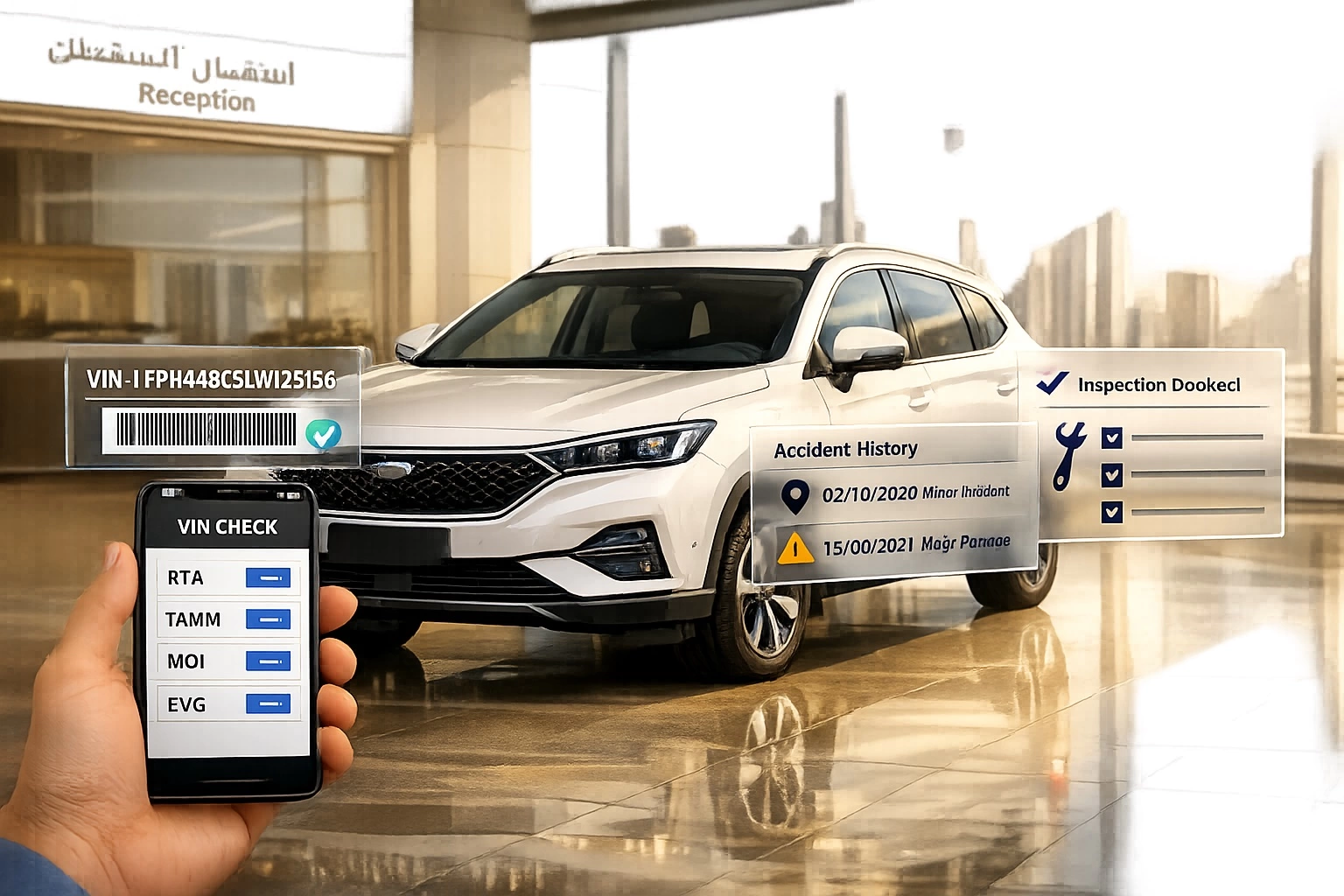
Buying a used Chinese car in the UAE? Here’s the most important step before paying a deposit: Verify the car’s VIN (Vehicle Identification Number) and accident history. Skipping this can lead to hidden costs, safety risks, or even legal issues.
Why It Matters:
-
32% of used cars in the UAE have been in accidents, often with concealed damage.
-
Accident history can reduce resale value by 20–30%, costing you thousands of dirhams.
-
Undisclosed repairs or unpaid fines can create insurance and registration headaches.
Key Steps to Protect Yourself:
-
Locate and Verify the VIN: Check the 17-digit VIN on the car (dashboard, door frame, or chassis) and ensure it matches the registration documents (Mulkiya).
-
Run Accident History Checks: Use platforms like the RTA (Dubai), TAMM (Abu Dhabi), MOI (nationwide), and EVG for insurance data. Costs range from AED 70–120.
-
Inspect for Red Flags: Look for mismatched paint, misaligned panels, or tampered VIN plates. These could indicate past accidents or fraud.
-
Get a Professional Inspection: Digital reports can miss hidden damage. A physical inspection (AED 99–199) checks the car’s mechanical and structural condition.
Pro Tip: If a seller refuses to provide the VIN, walk away - it’s a major warning sign.
Taking these steps ensures you avoid costly surprises and make a safe, informed purchase.
How to Check a Car by VIN Number | Full VIN Check Tutorial
Where to Find the VIN on a Chinese Car
Knowing where to locate and how to interpret your car's VIN is crucial for performing a reliable history check. This 17-character VIN serves as a unique identifier for your vehicle - no two cars in the world share the same code. Before running any history checks, find this number on the vehicle and confirm it matches the details on the Mulkiya (vehicle registration card).
Standard VIN Locations in Chinese Vehicles
Chinese vehicles adhere to international standards for VIN placement, but pinpointing its exact location can save you time. Start by checking the lower-left corner of the dashboard on the driver’s side, which is visible through the windscreen without opening the car. You can also open the driver’s door and inspect the B-pillar or door jamb, where a metal plate or sticker often displays the VIN alongside tyre pressure and manufacturing details. Additionally, open the bonnet to look for the VIN near the firewall or engine block. On some models, the VIN is stamped on the front frame near the wheel area.
Always compare the physical VIN with the one on your Mulkiya, insurance policy, and technical inspection certificates. Any mismatch could indicate fraud or undisclosed repairs. Examine the VIN closely for any signs of tampering, such as inconsistent fonts, uneven spacing, grinding marks, welding, or freshly applied paint around the area. A genuine VIN will have uniform engraving and spacing.
Once you’ve located the VIN and checked for irregularities, you can move on to decoding its structure for more detailed information about the vehicle.
How to Read the 17-Character VIN
The VIN isn’t just a random string of characters - it reveals key details about the car’s origin and specifications. The first three characters make up the World Manufacturer Identifier (WMI), which identifies the country of origin and manufacturer. For cars made in China, the VIN typically starts with 'L'. For instance, 'LVS' signifies a Chery vehicle manufactured in China.
Characters 4 through 9 form the Vehicle Descriptor Section (VDS), which provides information about the model, engine type, body style, and safety features. The 9th character is a security check digit used to verify the VIN’s authenticity and detect alterations. The 10th character represents the model year (e.g., 'P' for 2023), although this might reflect the model cycle rather than the exact production year. The 11th character identifies the assembly plant, while characters 12 to 17 make up the unique serial number, often referred to as the "Chassis Number" in the UAE.
To avoid confusion, the letters 'I', 'O', and 'Q' are excluded from VINs because they resemble the numbers 1 and 0. With this understanding, you’re ready to use the VIN for official history checks through UAE government platforms.
Complete Workflow: How to Verify VIN and Accident History in the UAE
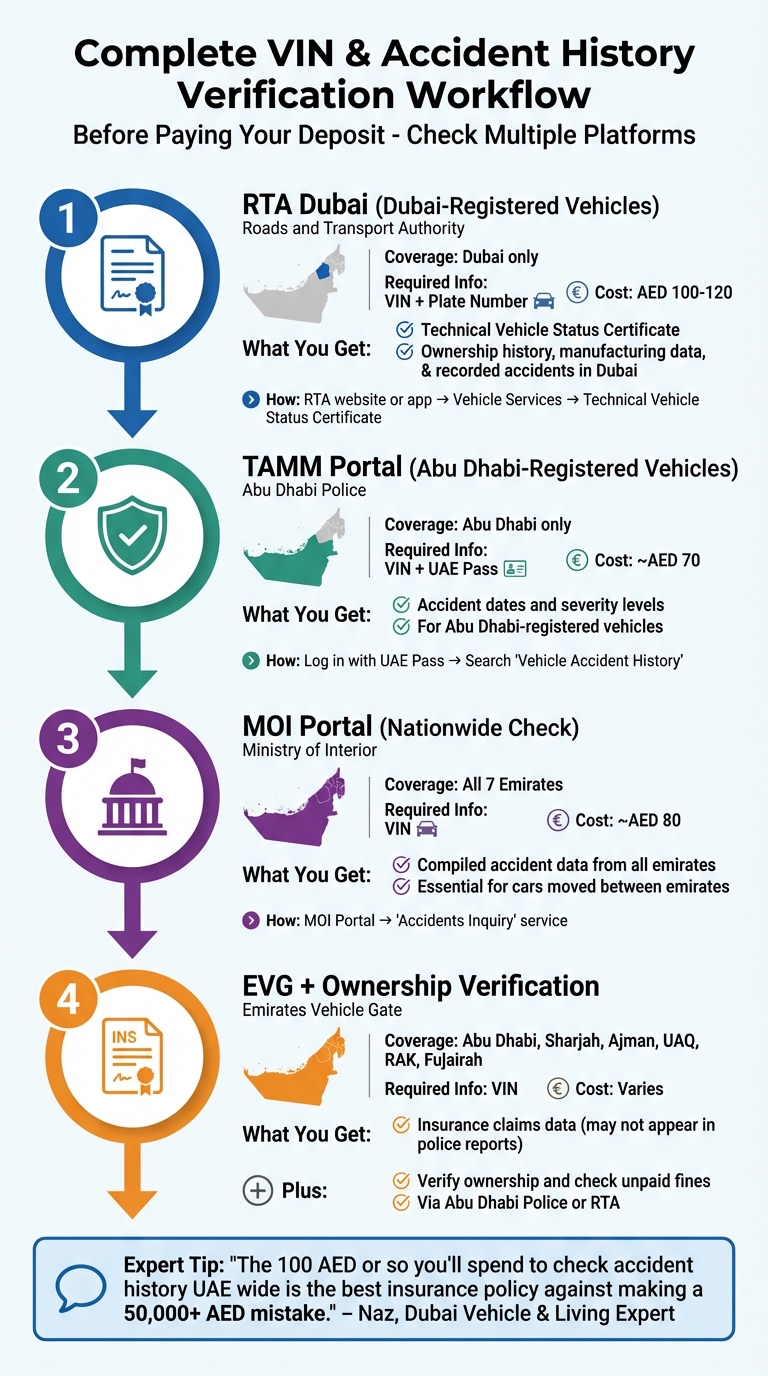
4-Step VIN and Accident History Verification Workflow for Used Cars in UAE
Before putting down a deposit on a car in the UAE, it’s crucial to verify the VIN (Vehicle Identification Number) and accident history. This step helps uncover hidden issues that could cost you later. Since the UAE doesn’t have a single, unified vehicle database, you’ll need to check multiple platforms, as each emirate maintains its own records.
Start with the Roads and Transport Authority (RTA) if the car is registered in Dubai. Head to the RTA website or use their app, go to the vehicle services section, and select "Technical Vehicle Status Certificate." Enter the VIN and plate number, and pay AED 100–120 to get a certified report. This report provides details like ownership history, manufacturing data, and any recorded accidents in Dubai.
If the car is registered in Abu Dhabi, use the TAMM portal. Log in with your UAE Pass, search for "Vehicle Accident History", and pay about AED 70. This report outlines accident dates and severity levels for vehicles registered in Abu Dhabi.
For cars that may have moved between emirates, check the Ministry of Interior (MOI) portal. The "Accidents Inquiry" service costs around AED 80 and compiles accident data from all seven emirates. After reviewing accident records, confirm ownership details to complete your evaluation.
Next, visit Emirates Vehicle Gate (EVG) for insurance records. This platform covers Abu Dhabi, Sharjah, Ajman, Umm Al Quwain, Ras Al Khaimah, and Fujairah. EVG can reveal insurance claims that might not appear in police reports.
Don’t forget to verify ownership and clear any unpaid fines. Use the Abu Dhabi Police portal or the RTA website with the plate number for this step. Unpaid traffic fines must be settled before transferring ownership, and a history of frequent violations could indicate careless prior ownership.
Here’s a quick summary of the platforms, what they cover, and their costs:
|
Platform |
Best For |
Coverage |
Required Info |
Cost (AED) |
|---|---|---|---|---|
|
RTA Dubai |
Dubai-registered vehicles |
Dubai only |
VIN + Plate Number |
100–120 |
|
TAMM (Abu Dhabi Police) |
Abu Dhabi-registered vehicles |
Abu Dhabi only |
VIN + UAE Pass |
~70 |
|
MOI (Ministry of Interior) |
Vehicles moved between emirates |
Nationwide |
VIN |
~80 |
|
EVG (Emirates Vehicle Gate) |
Insurance data & Northern Emirates |
Abu Dhabi, Sharjah, Ajman, UAQ, RAK, Fujairah |
VIN |
Varies |
"The 100 AED or so you'll spend to check accident history UAE wide is the best insurance policy against making a 50,000+ AED mistake." – Naz, Dubai Vehicle & Living Expert
For imported vehicles, UAE platforms only display records after the car was brought into the country. To check its history in China or other countries, you’d need to use international VIN decoders. However, these tools are often incomplete, especially for vehicles initially sold in the Chinese market.
YallaMotor Vehicle Inspection Service: Professional Assessment
Digital records can only tell part of a car's story. They document reported incidents but often miss privately resolved repairs or out-of-pocket fixes, leaving gaps in the vehicle's history. To truly understand a car's condition, a hands-on professional inspection is essential. This type of evaluation focuses on the vehicle's current mechanical state, rather than just its documented past.
YallaMotor offers an extensive database of over 10,000 verified car listings in the UAE, all carefully vetted for quality. For those looking for a deeper dive into a vehicle's history, YallaMotor's partner service provides a detailed report for AED 99. This report pulls data from over 100,000 sources across 24 countries, making it especially useful for imported cars, like Chinese models, where UAE portals might lack complete records.
What Gets Inspected
A professional inspection goes beyond what digital reports can capture, covering five key areas:
-
Exterior: This includes checking paint consistency, panel gaps, rust, and tyre tread depth. Misaligned doors or bonnets can indicate past accidents.
-
Interior: Seats, dashboard, upholstery, air conditioning, infotainment systems, and power windows are thoroughly tested to ensure functionality.
-
Mechanical: Inspectors listen for engine noise, check for vibrations, verify fluid levels, and assess brakes, steering, and clutch performance.
-
Structural: This involves examining chassis alignment, welding marks, and underbody rust, which could point to hidden damage despite cosmetic repairs.
-
Safety Systems: Airbag presence and functionality are verified, ECU scans are conducted, and dashboard warning lights are checked. It's not uncommon for deployed airbags to go unreplaced, even when reports suggest otherwise.
|
Inspection Area |
Specific Components Checked |
|---|---|
|
Exterior |
Paint consistency, panel gaps, rust, tyre tread depth, and wear patterns |
|
Interior |
Seats, dashboard, upholstery, AC, infotainment, and power windows |
|
Mechanical |
Engine noise, vibrations, fluid levels, brakes, steering, and clutch |
|
Structural |
Chassis alignment, welding marks, and underbody rust |
|
Safety |
Airbag presence, ECU/airbag scans, and dashboard warning lights |
This thorough inspection ensures that no detail is overlooked, giving you a clear picture of the car's actual condition.
How to Book Your Inspection on YallaMotor
Booking an inspection with YallaMotor is quick and easy. You can arrange the service directly through their platform or via their partner, Vehicle Report. Simply select the car you're interested in, request an inspection, and schedule a time that works for you. Comprehensive reports typically cost between AED 99 and AED 199.
Warning Signs in VIN and Accident Reports
When verifying used Chinese cars in the UAE, it’s essential to scrutinise accident histories and ownership details. By carefully analysing VIN and accident reports, you can spot red flags that may help you avoid costly mistakes. These warning signs generally fall into two categories: evidence of serious physical damage and indicators of ownership fraud or tampering. Let’s break down the key signs of structural damage and ownership inconsistencies.
Signs of Serious Accidents or Major Repairs
Structural damage is one of the most critical red flags to watch for. Reports mentioning issues like chassis or frame damage, suspension repairs, or structural beam work are clear indicators that the car’s safety shell has been compromised. Such damage can significantly reduce crash protection. Similarly, if an airbag has been deployed but lacks proper documentation of professional replacement, the reliability of the car’s safety systems is questionable.
Pay attention to terms like "salvage", "total loss", or "refurbished" in insurance records. These labels mean the car was previously deemed uneconomical to repair by an insurer. Flood or water damage is another major concern, as it can lead to long-term electrical issues and corrosion, which may not appear immediately but could cause problems down the line. Lastly, if the mileage recorded in the car’s history doesn’t match the dashboard reading, it could indicate odometer tampering.
|
Category |
Indicator |
Risk |
|---|---|---|
|
Structural |
Chassis/frame damage, suspension repairs |
Critical (Safety Risk) |
|
Safety Systems |
Airbag deployment, seatbelt pretensioner |
Critical (Safety Risk) |
|
Legal/Fraud |
VIN mismatch, salvage title, theft record |
High (Legal/Financial Risk) |
|
Maintenance |
Odometer rollback, major engine rebuild |
High (Financial Risk) |
|
Environmental |
Flood damage, saltwater immersion |
High (Reliability Risk) |
Fraudulent documentation is another area that requires careful attention.
Ownership Problems and Fraud Indicators
Ownership discrepancies are a major red flag, and they often indicate fraud. For example, a mismatch between the car’s VIN and the number on its Mulkiya (registration card) is a clear sign of potential tampering.
"One of the largest indications of fraud is a difference in VIN numbers on the car and documents. It may reflect a history of tampering, a replacement of parts or a stolen car" - AutoFix
A missing or altered VIN is an equally serious issue. If the VIN plate looks scratched, altered, or is missing altogether, it’s best to walk away from the deal. Additionally, if the seller cannot provide the VIN, this should immediately raise suspicion.
Another factor to consider is the car’s ownership history. A vehicle with an unusually high number of previous owners in a short time frame might be a "lemon", plagued by recurring mechanical problems. For imported Chinese cars, keep in mind that UAE portals may display a "clean" report even if the vehicle had a salvage title in its country of origin. To avoid surprises, cross-check the information across multiple platforms like RTA, MOI, EVG, and TAMM.
Final Checklist: What to Do Before Paying Your Deposit
Before handing over your deposit, make sure you’ve ticked off these crucial checks. A 2024 Roads and Transport Authority (RTA) report found that 38% of used cars in Dubai had hidden accident histories. Plus, cars with repair claims exceeding AED 5,000 often come with 23% higher long-term maintenance costs.
Here’s how to ensure everything is in order before committing.
Double-Check All Reports and Documents
-
Match the 17-digit VIN on the Mulkiya with the numbers on the car’s dashboard, door frame, and chassis.
-
Verify accident records with data from the RTA, Dubai Police, TAMM, and Emirates Vehicle Gate (EVG) to avoid inconsistencies.
-
Check for unpaid traffic fines using the Dubai Police or RTA platforms, as these must be cleared before transferring ownership.
-
Ensure the seller has obtained a bank’s No Objection Certificate (NOC) if the car is financed.
-
Request complete service records to confirm regular maintenance and identify any major past repairs.
Once you’ve reviewed the documents, shift your focus to verifying the seller’s credibility.
Confirm the Seller's Identity and Reputation
-
Be cautious if the seller hesitates to provide the VIN. Nearly 20% of buyers from online listings report this issue.
"It's a red flag. Always insist on obtaining the chassis number to perform necessary checks" - Amgad El Sabbagh, YallaMotor.
-
Purchase the RTA Technical Vehicle Status Certificate (cost: AED 120) to review the car’s ownership history and insurance details.
Complete an Inspection and Test Drive
-
Keep in mind that digital accident reports won’t include privately repaired damage.
"Digital history reports on accidents are useful, however they never include the entire story. Numerous accidents go unreported, they are repaired privately or leave the unnoticed structural damage that can be revealed only by a professional" - AutoFix.
-
Look for signs of prior repairs, such as mismatched paint shades or overspray on rubber seals.
-
Check for proper alignment of the doors, bonnet, and boot. Misaligned gaps might indicate structural damage from a collision.
-
During your test drive, pay attention to engine sounds, vibrations, and any issues with the brakes, steering, or gears.
-
Even if you’re confident in your car knowledge, it’s wise to hire a trusted mechanic or professional inspection service to perform a detailed pre-purchase evaluation.
FAQs
What if the VIN on the car doesn’t match the Mulkiya?
If the VIN on the car doesn’t match the Mulkiya, it could indicate a discrepancy or even potential fraud. Always check the vehicle’s history through official channels to confirm its authenticity. Taking this step helps you steer clear of any risks tied to the purchase.
How do I check accident history if the car moved between emirates?
To check a car's accident history across the emirates, you can use official platforms such as the Ministry of Interior (MOI), Emirates Vehicle Gate (EVG), or Abu Dhabi Police. All you need is the vehicle’s VIN or chassis number. These platforms provide detailed reports, including accident records from various emirates, ensuring you have a clear understanding of the vehicle's history.
Do I still need a physical inspection if the reports look clean?
Yes, getting a physical inspection is strongly advised, even if the reports look perfect. It allows you to check the car's real condition, spot any hidden issues, and confirm its safety. This extra step can give you greater confidence before finalising your purchase.
Looking for a used car in Dubai or new car deals? Explore YallaMotor’s verified listings today.