If my car stops in Abu Dhabi, I need to do three things first: get to a safe spot, share my exact location, and ask for the right type of help.
In most cases, I’m choosing between roadside help for small issues, flat-bed towing for cars that should not be driven, and specialist recovery for sand, basement access, or winching jobs. For many roadside call-outs in Abu Dhabi, arrival is often around 30 to 60 minutes, but the final wait time depends on traffic, distance, and where the car is.
Here’s the short version of what matters most:
Roadside help suits a flat battery, puncture, or fuel delivery
Towing suits breakdowns, overheating, accident damage, or transmission faults
Specialist recovery suits desert sand, low-clearance basements, and tight access
I should ask for the full price in AED before the job starts
I should confirm 24/7 service, coverage area, truck type, and UAE licensing
It helps to keep Emirates ID, Mulkiya, and insurance details ready
Quick comparison
Service | Best for | What I should tell the provider |
|---|---|---|
Roadside assistance | Battery jump-start, tyre change, fuel delivery | My location, the fault, and whether I have a usable spare tyre |
Flat-bed towing | Non-drivable cars, accident recovery, overheating, gearbox issues | My vehicle type, destination, and if the car is in a car park or on a highway |
Specialist recovery | Desert pull-out, winching, basement recovery | Sand condition, access height, and if a low-profile truck or winch is needed |
The main point is simple: I save time when I match the problem to the right service from the start, especially in Abu Dhabi’s heat, long road stretches, and remote areas.
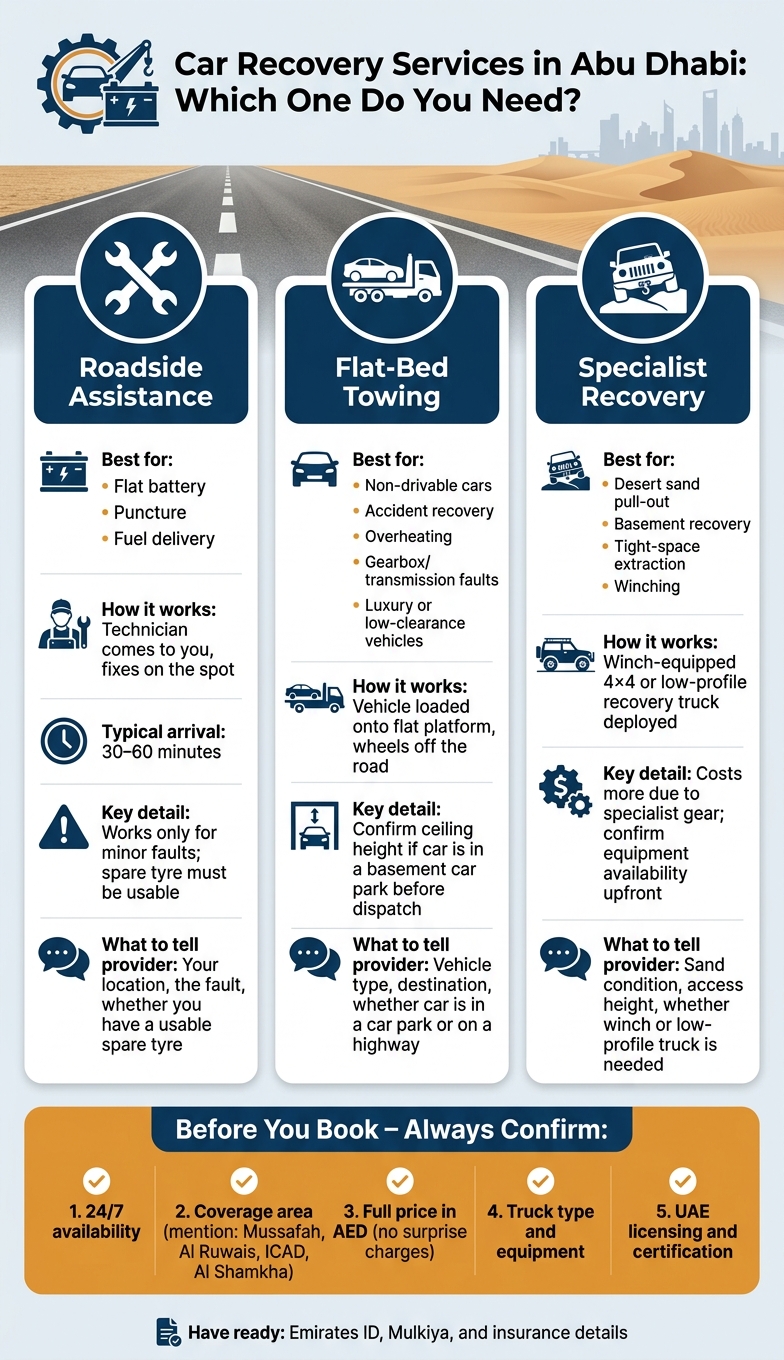
Car Recovery Services in Abu Dhabi: Which One Do You Need?
Common reasons drivers call for car recovery in Abu Dhabi
These are the call-outs recovery teams deal with most on Abu Dhabi roads. Some jobs are simple roadside fixes. Others need a tow truck or specialist winching gear.
Breakdowns, flat batteries, punctures, and fuel delivery
Flat batteries, punctures, and running low on fuel are the most common roadside issues. In many cases, the fix is straightforward: a jump-start, a tyre change, or fuel delivery.
Some problems are more serious. If a car is overheating or has a cooling-system fault, it often needs a flat-bed tow instead of a roadside fix. On major bridges and highways, a broken-down car can hold up traffic in no time. If the vehicle can't be sorted on the spot, towing is usually the safer choice.
Basement parking recovery, desert pull-out, and winching
Some recoveries need more than a standard tow truck. Basement car parks, for example, can be a headache because of low height limits. In those cases, a low-profile tow truck is often the only way to get the vehicle out.
Soft sand is a different problem altogether. When a car gets bogged down in the desert, it usually needs winching to pull it free.
Accident recovery and vehicle relocation
After an accident, a non-drivable car will usually need flat-bed transport. It’s then taken to a workshop or an impound yard. The same applies to vehicles that have failed inspection or are otherwise not roadworthy and need to go to a repair facility.
That first check matters. It tells the recovery team whether the job calls for roadside help, towing, or a specialist recovery service.
The next step is matching each situation to the right recovery service.
Types of car recovery services and what each one is best for
Pick the lightest service that can fix the issue safely. Once you know what's wrong, match it to the least disruptive recovery option.
Roadside help: jump-starts, tyre changes, and fuel delivery
Roadside assistance covers the most common call-outs: a flat battery, a punctured tyre, or an empty tank. A technician comes to your location, fixes the issue on the spot, and you can usually get moving again straight away.
But there's a limit. Roadside help works only for minor faults. A jump-start helps only when the battery is the issue. If the car has a mechanical or electrical fault, you'll still need towing. The same goes for tyre changes: they work only if the spare is in usable condition. If the damage is severe, towing is the safer option.
Towing and flat-bed transport for non-drivable vehicles
If the car can't be driven safely, flat-bed transport is often the right choice. The vehicle is loaded onto a flat platform, so its wheels don't touch the road at all.
This is a good fit for low-clearance or luxury cars, and for any vehicle with a transmission fault, where two-wheel towing can damage the drivetrain. After an accident, flat-bed recovery will often take the car to a workshop or a recovery yard.
Here's one detail that matters more than people think: larger flat-bed trucks can struggle to get into basement car parks with low ceiling clearance. If the vehicle is underground, tell the provider the exact height restriction before they send a truck. That one detail can save time, hassle, and a wasted dispatch.
Winching and specialist recovery for difficult locations
Desert pull-outs, basement recoveries, and tight-space extractions need specialist equipment. A winch can pull a vehicle free, while low-profile recovery trucks are made for low-clearance spaces.
These jobs usually cost more because of the gear involved, and not every provider has what the job needs. It's best to confirm this upfront. For example:
A winch-equipped 4x4 for desert recovery
A low-profile recovery truck for basement access
That way, the team arrives with the right setup instead of figuring it out after they get there.
After choosing the service type, the next step is staying safe and checking the provider's coverage area, response time, and licensing.
What to do when stranded and how to pick a reliable recovery provider
Once you’ve worked out the right type of service, the next step is simple: stay safe and give the dispatcher the details they need.
Steps to stay safe while waiting for help
If your car breaks down, move it away from live traffic if you can, then switch on your hazard lights. Keep a reflective warning triangle, fire extinguisher, spare tyre, and first-aid kit in the car. Stay away from the road while you wait, and call a licensed recovery provider.
When you call for help, share your exact location. GPS coordinates are best, but a clear landmark also helps. Then explain the issue plainly: name the exact fault and say whether the car is on a highway, in a car park, or stuck in sand. That gives the dispatcher a much better shot at sending the right recovery truck or roadside support the first time.
Once you’ve shared your location and the problem, compare providers based on ETA, coverage, and equipment.
How to compare providers: response time, coverage, capability, and licensing
Coverage differs from one provider to another. Abu Dhabi is large, so it’s worth confirming that they can reach your exact location before you book.
Criteria | Why it matters | What to confirm before booking |
|---|---|---|
Response time | Cuts down the time you spend in roadside risk | Ask for a specific ETA |
Coverage area | Abu Dhabi is vast; some providers don't service remote areas | Confirm they cover your specific zone - Mussafah, ICAD, or Al Ruwais |
Capability | Different vehicles need different equipment | State your vehicle type and whether it is stuck in sand or a basement |
Licensing | Authorised providers follow local safety and transport standards | Verify they are a certified recovery service in the UAE |
Pricing transparency | Helps you avoid surprise charges after the vehicle is already hooked up | Request a clear quote in AED for the recovery and destination |
Also, treat 24/7 availability as the bare minimum, not a bonus.
Using YallaMotor to plan your next step after recovery

Use YallaMotor to check value, find workshops in Abu Dhabi, and decide whether to repair or replace.
Coverage areas, pricing factors, and key takeaways
Where services operate and how long they take to arrive
After you figure out the right type of recovery, the next thing to check is simple: can the provider get to your exact spot in Abu Dhabi without delay?
Most recovery companies in Abu Dhabi cover central districts, industrial zones, and outer areas like Al Shamkha, Al Ruwais, and Madinat Zayed. That sounds straightforward, but arrival time can still vary. It usually comes down to distance, traffic, and the time of day. Early mornings and non-rush-hour periods are often faster.
For a minor roadside call-out, the usual arrival window is 30 to 60 minutes.
What affects the final price in AED
Coverage is one part of the choice. The other part is what the job actually involves.
The final price in AED depends on the vehicle type, the towing distance, and whether the job needs flat-bed towing or winching. If access is difficult, the cost can go up. That includes places like a basement car park or a remote industrial site.
Before you approve the job, confirm:
the full scope of the recovery
the final price in AED
whether tools like a winch are already included in the quote
It also helps to have your Emirates ID, Mulkiya, and insurance details ready.
Conclusion: Getting back on the road quickly and safely
Once coverage and price are clear, the last step is choosing the safest option for the vehicle’s condition.
Match the service to the issue, confirm that the provider covers your exact location, and agree on the price in AED before work starts. If speed matters most, go with 24/7 recovery support that has the right equipment for your vehicle and location.
FAQs
Does my insurance cover car recovery in Abu Dhabi?
It depends on the terms of your policy. Some insurance plans include 24/7 roadside assistance as a standard feature or optional add-on, but not every policy comes with it.
Check your policy documents or contact your insurer to confirm whether services like towing, battery jump-starts, or flat tyre support are covered. If they’re not, you can still book recovery services directly through YallaMotor.
Can a recovery truck tow my car from underground parking?
Yes, many professional car recovery services in Abu Dhabi can recover vehicles from underground parking.
They often use low-clearance tow trucks or winching equipment made for basement and indoor car parks. When you call for help, tell the provider that your car is in underground parking so they can send the right equipment.
What details should I send when I ask for recovery help?
When you ask for recovery help in Abu Dhabi, send your exact location, the issue with the car, and your vehicle’s make and model.
For example, mention whether it’s a flat tyre, dead battery, or an accident. That gives the dispatch team a clear picture from the start.
It also helps to share your contact details so they can reach you fast, coordinate the pickup, and keep you updated on the estimated arrival time.