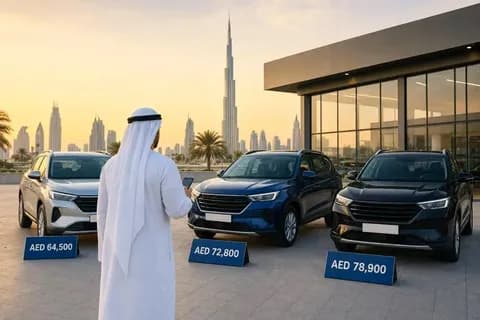
If I want the most money for my car, I usually sell it privately. If I want it gone fast, I trade it in. That’s the whole decision in one line.
Here’s the short version:
Dealer trade-ins often come in 20% to 30% below market price
Private sales usually bring the best price, but can take 2 to 8 weeks
Financed cars need a bank settlement letter and NOC, which often takes 3 to 7 working days
Full service history, GCC specs, low mileage, and clean accident history help price
Major accident history, non-GCC specs, and warning lights can pull offers down hard
In Dubai, transfer fees are often around AED 370 to AED 420, and may reach AED 620 if testing is needed
A clean, well-priced listing with 15+ photos usually gets more buyer interest
If I were deciding today, I’d use a simple rule:
Take the trade-in if the dealer offer is within about 10% of what I think I can get privately
Sell privately if the offer is 20%+ lower and I have time to deal with calls, viewings, and transfer
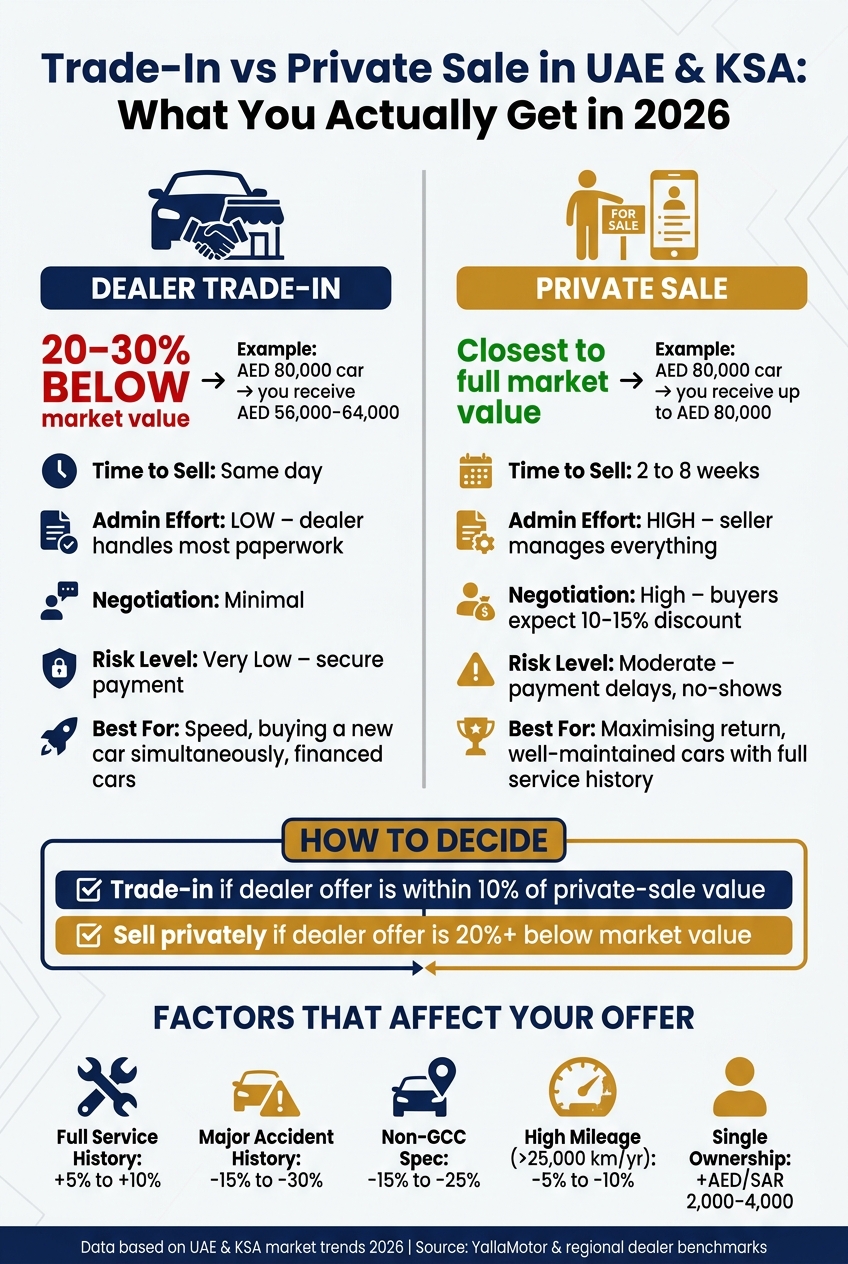
Trade-In vs Private Sale in UAE & KSA: What You Actually Get in 2026
Quick comparison
Factor | Trade-in | Private sale |
|---|---|---|
Money I get | Usually lower | Usually higher |
Time | Often same day | Often 2 to 8 weeks |
Admin | Dealer handles most of it | I handle it myself |
Risk | Lower | Higher |
Best fit | I need speed | I want more money |
In other words: I’m paying for convenience when I trade in, and I’m paying with time when I sell privately.
Dealer offer vs private-sale price: what sellers actually get
Typical price gap in the UAE and KSA
Once you understand the process, the next thing that matters is simple: how much less a dealer will pay.
In most cases, dealer trade-in offers land around 20–30% below private-sale value. So if your car is worth AED 80,000, you might get about AED 16,000–24,000 less than you would in a private sale. In Saudi Arabia, a car priced at SAR 80,000 can see much the same gap, which means roughly SAR 16,000–24,000 less.
That gap is not fixed. Some cars hold up better than others. It tends to shrink for vehicles that sell fast and have strong buyer demand. It often gets larger for cars that are harder to move, especially non-GCC-spec cars, unusual colours, or higher-mileage vehicles. A full service history can help push the offer up.
Why dealers pay less than private buyers
The reason is pretty straightforward. A dealer is not buying your car to drive it. They are buying it to resell.
That means they build their costs into the offer. Things like reconditioning, detailing, mechanical repairs, showroom running costs, and the risk of the car sitting in stock all come out of the price they give you. By contrast, a private buyer usually wants the car for personal use, so they do not carry those resale costs. That is why they will often pay much closer to market value.
Trade-in vs private sale: money, speed, and effort compared
Factor | Dealer Trade-In | Private Sale |
|---|---|---|
Price realised | 20–30% below market | Closest to market value |
Convenience | Dealer manages most admin | Seller manages everything |
Negotiation effort | Minimal | High - buyers expect to negotiate |
Risk | Very low - secure payment | Moderate - payment delays or failed transfers, and no-shows |
Best for | Buying a new car simultaneously | Maximising your return |
In short, the size of the gap comes down to the car itself: model, mileage, condition, and demand.
What affects your car's value before you decide
Once you know the dealer-private-sale gap, the next step is simple: work out which parts of your car make that gap smaller or bigger.
Make, model, year, mileage, and market demand
Some cars keep their value much better than others. In the UAE and KSA, Japanese and Korean brands tend to do better than many rivals. Toyota, Nissan, Honda, and Hyundai all benefit from dense service networks and easy-to-find parts. High-resale models include the Toyota Land Cruiser, Nissan Patrol, and Honda Civic.
Body style matters as well. SUVs account for 44% of all car searches in the UAE, while sedans make up 31%.
Mileage plays a big part too. Buyers across the region tend to prefer cars with less than 100,000 km, and prices often drop hard after 150,000 km. A handy rule of thumb is about 20,000 km per year. Age adds to that effect: in the UAE and KSA, the biggest drop in value usually comes in the first three years of ownership.
Colour can shape demand more than many owners expect. Neutral colours tend to sell faster.
Condition, service history, and accident record
Demand gives you the starting point. Condition decides whether your car lands above it or below it.
A full agency service history is one of the strongest signs of value. It shows the car has been looked after properly. In practical terms, a complete service record can add about AED 3,000 to AED 6,000 - or around 5% to 10% - to the value of a mid-range car.
Accident history has the biggest negative effect. A disclosed major accident or frame damage can cut a car's value by 15% to 30%. In this market, a clean history is not a bonus. It's the baseline many buyers expect.
Small issues matter too. Active dashboard warning lights can reduce dealer offers by AED 5,000 or more. Dealers usually price in any work they need to do before putting the car back on the market. That is why visible repair needs often hurt trade-in offers more than private-sale prices.
Dealers and private buyers also look at the same car in different ways:
Dealers focus on resale margin and often deduct heavily for reconditioning.
Private buyers focus more on reliability and history, so single-owner cars with full records can do better in a private sale.
A simple resale-value framework for AED and SAR estimates
These factors help decide whether your car sits near the top or bottom of the trade-in range. Start with the median price of similar listings, then adjust from there.
Use these adjustments to turn a listing price into a more realistic private-sale estimate:
Factor | Value Adjustment (Approximate) |
|---|---|
Full agency service history | +5% to +10% |
Non-GCC specification | -15% to -25% |
Major accident history | -15% to -30% |
Mileage above 25,000 km/year | -5% to -10% |
Single ownership | +AED/SAR 2,000 to +AED/SAR 4,000 |
Apply each adjustment to the median price of similar listings. That gives you a realistic private-sale estimate.
GCC-spec cars usually hold value better because they are easier to sell, insure, and service locally.
How to trade in or sell your car privately, step by step
Use the price range you worked out earlier to decide one thing: is a fast sale worth taking less money?
Step by step: trading in at a dealer
A trade-in is the easy route. It’s fast, simple, and often done the same day. But a bit of prep can still help you get a better figure.
Before heading to the dealer, clear any traffic fines, Salik dues, and parking fines. If the car is under finance, speak to your bank at least 3–7 working days in advance and ask for a settlement figure and a No Objection Certificate (NOC). Then go to the dealer once both documents are ready.
Bring these documents with you:
Emirates ID (original)
Mulkiya
Valid UAE driving licence
Passport copy with residency visa
Current insurance certificate
In KSA, you’ll usually need your National ID or Iqama with the Istimara. It also helps to have your full service history ready. A complete agency service history can add 5–10% to the car’s value.
Once the dealer checks and appraises the car, compare the offer against current listings for similar models. There usually isn’t much room to bargain, so your benchmark matters here. If the number feels low, use those market listings to push back.
After you agree on the price, cancel your insurance. You may get part of the unused premium back. Also remove the car from your Salik account.
Step by step: selling privately
If the dealer’s number is below your target, this is the other path.
Selling privately takes more work. But in most cases, it gives you more of the car’s market value than a dealer trade-in.
Start with how the car looks. First impressions do a lot of heavy lifting. A professional exterior detail usually costs AED 100–250, while an interior detail usually costs AED 200–400. Fix any dashboard warning lights before you post the ad. Active warnings can cut offers by AED 5,000 or more.
Then take proper photos. Aim for at least 15 clear images covering the exterior, interior, odometer, tyres, service book, and any damage. Buyers in the UAE tend to scroll fast, so poor photos can cost you before anyone even messages.
Set your asking price with a 10–15% buffer, since buyers usually expect to negotiate. If you want extra support for your price, you can get a Tasjeel market value certificate for AED 250–350.
For viewings, meet in public places like mall car parks or RTA centres. Before any test drive, always check the buyer’s UAE driving licence.
Payment is where you need to be strict. Do not sign RTA transfer papers until the money is confirmed in your bank account. Stay away from personal cheques. Use a verified bank transfer or a manager’s cheque that you confirm directly with the issuing bank.
Once payment is in, both sides can finish the transfer at an RTA Customer Happiness Centre, or through the Dubai Drive app using UAE Pass. Fees are about AED 370–420 for newer vehicles, and can go up to AED 620 if an inspection is needed.
After the transfer is done, cancel your insurance and remove the car from your Salik account on the same day.
That route only makes sense if the extra money is enough to cover the extra time and effort.
When each option makes more sense
Pick the route based on your deadline and how big the gap is between the two prices.
Scenario | Better Option | Reason |
|---|---|---|
Buying a new car from the same dealer | Trade-in | Simple, same-day transaction with no need to find a separate buyer |
Financed car with a tight timeline | Trade-in | Dealer can help with the settlement and transfer steps |
Well-kept car with full service history | Private sale | Good presentation and service records can support a higher price |
Urgent timeline | Trade-in | Speed matters more than the extra money from a private sale |
For cars in the AED 50,000–AED 100,000 range, a private sale usually makes sense if the car is clean and easy to show well.
Using YallaMotor data to make your decision
How to benchmark your car with YallaMotor
Once you know what drives your car’s price, the next step is simple: test it against the live market. Start with YallaMotor before you say yes to any dealer offer. Its free valuation tool uses live market data and transaction history to give you an instant market value for your car.
Then compare at least 10 similar listings. Match them as closely as possible by make, model, year, trim, and mileage. The highest priced matches can help you spot your ceiling, but don’t stop there. Focus only on matching GCC-spec cars with a similar service history, so your private-sale range in AED or SAR stays grounded in what buyers may actually pay.
A simple decision rule for 2026 sellers
Once you have a benchmark, judging a dealer offer gets much easier. Put the offer next to your YallaMotor estimate and look at the gap.
If the dealer offer is within 10% of your private-sale value, a trade-in can be worth it for the time you save. If it comes in more than 20% lower, selling privately is usually the better move. And if your ad gets weak interest after 10 to 14 days, trim the asking price and keep things moving.
Conclusion: the main points to remember
Trade-ins are quick and simple, but dealers often pay 20% to 30% below market value. Private sales take more time and effort, but they usually bring the best price, especially if the car is well maintained and comes with full service records.
Your car’s mileage, condition, service history, and market demand all shape what it’s worth. That’s why checking YallaMotor listings and running a valuation before you decide can make such a big difference. It gives you the one figure you need most when the negotiation starts: a clear starting point.
FAQs
How do I estimate my car’s real market value?
Start with YallaMotor’s AI-powered Car Valuation Tool to get an instant estimate based on your car’s make, model, year, mileage, and condition.
Then check that estimate against at least 10 similar live listings. Filter by mileage and region so you’re comparing like for like. That matters more than most sellers think. A car in Dubai with 80,000 km on the clock may not sit in the same price range as the same model in another emirate with very different usage.
If you want more backing before you negotiate, get a Car Valuation Certificate from an RTA-recognised inspection centre. It gives you a formal price reference you can use when buyers start pushing for a lower deal.
Should I fix minor issues before selling my car?
Yes. Fixing small issues before listing your car can help protect its value and make a better first impression.
Focus on visible or basic problems like:
Scratches
Broken light covers
Unpleasant odours
Weak air conditioning
Warning lights
Tyre tread
Fluid levels
These details make the car look well maintained and can give you a stronger position during negotiations.
What is the safest way to receive payment in a private sale?
The safest move is simple: hand over the vehicle only after the money has fully cleared in your bank account. Don’t trust screenshots, payment confirmations, or transfer alerts that haven’t been checked by your bank.
To lower the risk, complete the ownership transfer at an RTA-authorised centre. If the car is under finance, make sure the buyer’s payment covers the full outstanding loan and that the bank issues a No Objection Certificate for the transfer.